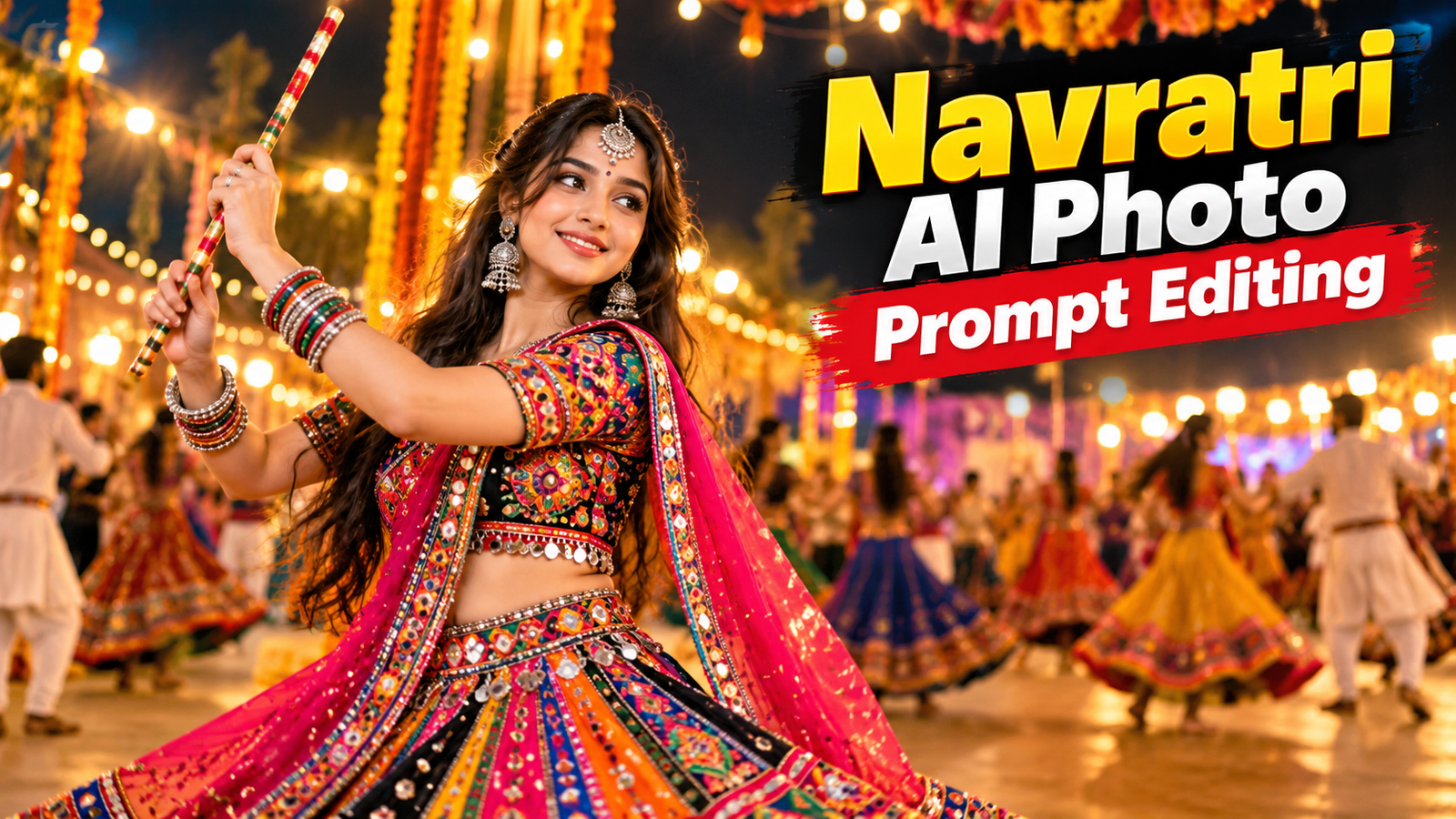
Navratri AI Photo Prompt Editing 2026: Navratri is increasingly becoming a visual festival on social media, where traditional clothing, Garba nights and Dandiya celebrations appear alongside AI-generated and AI-edited portraits. For users searching for Navratri AI photo prompt editing, the objective is not simply to add colourful lights or a festive background. A useful prompt must control what the AI changes while protecting the identity and natural appearance of the original photograph.
Sharad Navratri in 2026 begins on October 11 in India, according to Panchang-based calendar information. This makes the period particularly relevant for users preparing festival-themed social media posts and profile images.
What Is Navratri AI Photo Prompt Editing?
Navratri AI photo prompt editing means uploading an existing photograph to an AI image-editing tool and describing the desired changes through natural language. Google has officially introduced image editing in Gemini, allowing users to modify uploaded images, change backgrounds, replace objects and add visual elements through prompts.
The important distinction is between editing and completely regenerating an image. If the purpose is to retain the person’s identity, the prompt should explicitly ask the tool to preserve facial structure, skin tone, hairstyle, proportions and recognisable features.
How to Write a Better Navratri Editing Prompt
A practical prompt should specify four things: what must remain unchanged, what needs to be edited, the visual environment and the desired photographic quality.
This approach is more controlled than simply asking an AI tool to “make this a Navratri photo”. Recent Navratri prompt guides similarly emphasise preserving the face while separately describing clothing, lighting, setting and photographic characteristics.
Google Gemini AI Diwali Ai Photo Prompt 2025 diwali ai photo editing prompt, diwali ai image prompt
Why Face Preservation Matters
AI editing can unintentionally alter facial proportions, hands, jewellery and clothing when too many changes are requested simultaneously. A better workflow is to begin with one clear, well-lit photograph and make controlled modifications.
Google Photos also introduced prompt-based image editing in India, allowing users to describe edits using text or voice. The feature supports several Indian languages and incorporates Gemini capabilities for image transformations.
Competitive Advantage: Edit in Layers
The most useful technique for Navratri AI photo editing is layered editing. First change the outfit, then refine the background, and finally adjust lighting or photographic style. This can provide greater control than putting every desired transformation into one highly complicated instruction.
For social media creators, this also makes it easier to produce different versions from the same source photograph: a Garba portrait, a Dandiya-night image, a traditional ethnic portrait or a festive couple photograph.
What Users Should Keep in Mind
AI-generated or AI-edited images should not automatically be treated as authentic photographs. Google says images created or edited with its native image-generation technology include invisible SynthID watermarking, while Google Photos has also introduced Content Credentials for modified images.
The broader value of Navratri AI photo prompt editing therefore lies in creative expression rather than replacing genuine festival experiences. A carefully written prompt can turn an ordinary photograph into a convincing festive visual, but the quality depends on both the source image and the precision of the instructions.